
Study uncovers the virological characteristics of a novel group of coronaviruses - closely related to SARS-CoV-2 - circulating in horseshoe bats in Thailand.
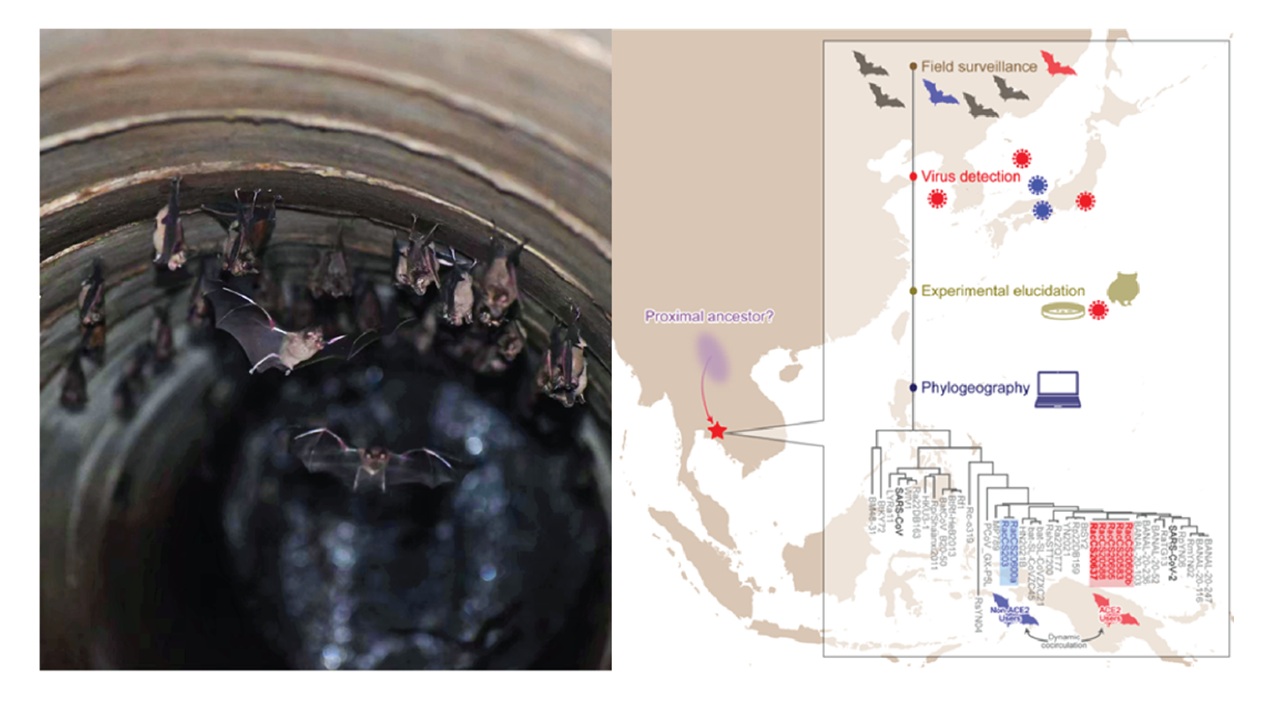
Horseshoe bats are the main host of coronaviruses related to SARS-CoV-2, the causative agent of the recent COVID-19 pandemic. Yet, the diversity and properties of bat SARS-CoV-2-related viruses remain unexplored, especially in Southeast Asia that harbors the largest number of horseshoe bat species. In a collaborative effort between the Institute of Medical Science, The University of Tokyo in Japan and Chulalongkorn University in Thailand, researchers discover a new group of these viruses sampled in acuminate horseshoe bats (Rhinolophus acuminatus) and compare their virological characteristics to these of SARS-CoV-2. The study reveals important insights into the features that make these viruses capable of jumping into humans by combining wildlife virus surveillance, laboratory molecular virology experiments and computational methods to trace the geographic movement and history of the viruses.
This is the first work of a new international research consortium, the Genotype to Phenotype Asia (G2P-Asia) Consortium1, in collaboration with Chulalongkorn University, formed as a continuation of the Genotype to Phenotype Japan (G2P-Japan) Consortium2, led by Prof. Kei Sato of the Division of Systems Virology at The Institute of Medical Science, The University of Tokyo. The study was published in Cell on May 6, 2026.
The new group of SARS-CoV-2-related viruses, referred to by the researchers as Clade B, is the second type of coronaviruses found in bats inhabiting the same artificial cave in Thailand’s Chachoengsao Province. The first group, Clade A3, was also found co-circulating with the newly discovered Clade B, even infecting the same individual bat. The difference between the two clades is that, unlike Clade A, Clade B viruses can engage the same human receptor that SARS-CoV-2 uses to infect humans, called angiotensin-converting enzyme 2 - or ACE2 for short.
Dr. Spyros Lytras, one of the study’s co-first authors, says that “This is clear evidence that SARS-CoV-2-related viruses which utilise different entry receptors co-circulate in and co-infect the same bat populations, opening up the possibility that they can swap parts of their genome through recombination and readily change their receptor usage”.
The researchers were able to synthetically produce a representative Clade B virus, called RacCS20637, to study virological properties beyond receptor usage. All experiments involving these viruses, were conducted in a Biosafety Level 3 laboratory at the Institute of Medical Science, The University of Tokyo, with approval from Japan’s Minister of Education, Culture, Sports, Science and Technology and the University of Tokyo Research Microbial Safety Committee.
These results indicated that, compared to SARS-CoV-2, RacCS20637 also binds the human ACE2 receptor efficiently but replicates much slower in human cells. Furthermore, RacCS20637 infection in hamsters caused little to no pathology and the virus was not capable of transmitting between individual hamsters.
“Although we cannot know how RacCS20637 infection behaves in horseshoe bats, this virus is much worse at replicating in human cells than SARS-CoV-2, while showing no pathology or transmission in the animal systems we use to study SARS-CoV-2” said Dr. Wilaiporn Saikruang, another co-first author of the study.
Reassuringly, the RacCS20637 virus is neutralised by sera from people who had received three doses of the COVID-19 vaccine, while also being effectively targeted by available antiviral drugs used for SARS-CoV-2.
Prof. Kei Sato, the co-senior author of the study, commented that “Despite their close relatedness to SARS-CoV-2, this particular group of coronaviruses poses no threat to humans. However, our findings highlight how SARS-CoV-2-related coronaviruses can readily alter their virological properties with only few changes in their genomes”.
The team further analysed the recent geographic movement of both Clade A and Clade B viruses that led them to infect the same bat population at the time of sampling. Their results show a complex network of virus movement across overlapping horseshoe bat host ranges in Southeast Asia with Clade B likely making its way to Eastern Thailand from northern parts of the peninsula, near Laos.
Prof. Sato added that “In this study, we expanded the research consortium The Genotype to Phenotype Japan (G2P-Japan) Consortium into an international collaborative research consortium with teams from Asian countries, known as The Genotype to Phenotype Asia (G2P-Asia) Consortium. Both G2P-Japan and G2P-Asia are conducting basic virological research aimed at establishing systems to prepare for the ‘next pandemic’. By focusing on Southeast Asia—where, as in this study, a large number of SARS-CoV-2-related coronaviruses have been detected—we are promoting research to investigate and identify high-risk viruses and experimentally elucidate their virological characteristics. Through such research, we aim to discover the scientific insights necessary to establish better infectious disease control systems before the ‘next pandemic’ occurs and to share these findings with the global community”.
Notes
1 Research Consortium “The Genotype to Phenotype Asia (G2P-Asia) Consortium”A research team led by Professor Kei Sato of the Division of Systems Virology at the Institute of Medical Science, The University of Tokyo. This research consortium was established specifically to facilitate collaborative research with countries across Asia.
2 Research Consortium “The Genotype to Phenotype Japan (G2P-Japan) Consortium”
A research team led by Professor Kei Sato of the Division of Systems Virology at the Institute of Medical Science, The University of Tokyo. Several young researchers and laboratories in Japan are participating in this initiative, collaborating to accelerate research. Currently, the consortium expands research fields from SARS-CoV-2 to a variety of pathogenic viruses to prepare for the next pandemic in the future.
3 The Clade A
A group of related coronaviruses was first reported in Wacharapluesadee et al. Evidence for SARS-CoV-2 related coronaviruses circulating in bats and pangolins in Southeast Asia. Nat Commun 12, 972 (2021).https://doi.org/10.1038/s41467-021-21240-1.
Paper information
Journal: CellTitle: Virological characteristics of SARS-CoV-2-related coronaviruses dynamically circulating in Southeast Asia
Authors: Supaporn Wacharapluesadee#, Wilaiporn Saikruang#, Spyros Lytras#, Kanata Matsumoto, Keiya Uriu, Alfredo Hinay Jr., Ziyi Guo, Khwankamon Rattanatumhi, Ananporn Supataragul, Sasiprapa Ninwattana, Nattakarn Thippamom, Tanawut Srisuk, Patarapol Maneeorn, Kirana Noradechanon, Prateep Duengkae, Nutthinee Sirichan, Yusuke Kosugi, Shigeru Fujita, Maximilian Stanley Yo, Ryo Matsunaga, Bingjie Hu, Lianzhao Du, Lei Wang, Masumi Tsuda, Yoshitaka Oda, Hesham Nasser, Kanako Terakado Kimura, Hiroaki Akasaka, Hiroyuki Asakura, Mami Nagashima, Kenji Sadamasu, Kazuhisa Yoshimura, Yuki Yamamoto, Tetsuharu Nagamoto, Takanori Asakura, Wataru Shihoya, Takao Hashiguchi, Terumasa Ikeda, Shinya Tanaka, Hin Chu, Kouhei Tsumoto, Osamu Nureki, The Genotype to Phenotype Japan (G2P-Japan) Consortium, The Genotype to Phenotype Asia (G2P-Asia) Consortium, Arnon Plianchaisuk, Opass Putcharoen*, Kei Sato*
(#Equal contribution; *Corresponding author)
DOI: 10.1016/j.cell.2026.04.019
URL: https://www.cell.com/cell/fulltext/S0092-8674(26)00454-X
Contacts
Research contact:Division of Systems Virology, Department of Microbiology and Immunology, The Institute of Medical Science, The University of Tokyo
Prof. Kei Sato
https://www.ims.u-tokyo.ac.jp/imsut/en/lab/ggclink/section04.html
Media Contact:
Project Coordination Office (Public Relations), The Institute of Medical Science, The University of Tokyo
http://www.ims.u-tokyo.ac.jp/imsut/en