
Researchers show that pharmacological activation of YAP/TAZ accelerates recovery of bone marrow microenvironment and promotes hematopoietic regeneration
Myeloablative therapies such as radiation and chemotherapy damage not only hematopoietic cells but also the bone marrow (BM) niche—the specialized environment that supports BM cells. However, the mechanisms and therapeutic strategies for BM niche recovery after injury remain unclear. Now, researchers have identified the role of YAP/TAZ signaling pathway that regulates the BM niche and developed a novel small molecule that promotes niche recovery and thereby accelerates hematopoietic regeneration.
A healthy bone marrow (BM) produces nearly all types of cells in our blood. Many blood disorders occur when hematopoietic stem cells (HSCs) in the BM malfunction. Many blood disorders and cancers are treated with radiation or chemotherapy, which as a side effect depletes not only tumor cells but also hematopoietic cells including HSCs in the BM—a condition known as myelosuppression. In severe cases, HSC transplantation (HSCT) is required to restore hematopoiesis. The BM niche is a complex environment comprising supporting cells such as endothelial cells (ECs) and mesenchymal stromal cells (MSCs) that sustain HSC activity. These cells are also damaged during myeloablative therapies, and their poor recovery can lead to reduced chemotherapy and HSCT efficacy. However, the mechanisms underlying the BM niche recovery remain elusive, and therapeutic strategies targeting niche recovery are underdeveloped.
To address this, a team of researchers led by Professor Atsushi Iwama from The Institute of Medical Science, The University of Tokyo, Japan, along with Dr. Shun Uemura from The Institute of Medical Science, The University of Tokyo, Japan, Dr. Masayuki Yamashita from St. Jude Children’s Research Hospital, USA, and Dr. Taito Nishino from Nissan Chemical Corporation, Japan, conducted a study to define the role of two transcriptional co-activators YAP and TAZ in the BM niche during regenerative hematopoiesis, as well as to assess the therapeutic potential of YAP/TAZ activation. Their findings were published in the journal Blood on June 22, 2026.
The team generated a series of mouse models where YAP/TAZ genes had been knocked out specifically in either ECs, MSCs, or hematopoietic cells. Under steady-state conditions, mice with YAP/TAZ knockout in MSCs showed reduced HSC numbers in the BM and increased HSC mobilization into circulating blood, demonstrating that basal YAP/TAZ activity in MSCs is essential for retaining HSCs in the BM. By contrast, YAP/TAZ in hematopoietic cells was found to be largely dispensable under both steady-state and post-injury conditions. When exposed to radiation, hematopoietic recovery was significantly impaired in mice with YAP/TAZ knockout in MSCs, while loss of YAP/TAZ in ECs led to pronounced blood vessel dilation, indicating that YAP/TAZ in both MSCs and ECs plays a critical role in BM niche recovery after injury. Mechanistically, YAP/TAZ regulates key transcription factors such as Ebf1 and Ebf3 in MSCs, preserving MSC identity and promoting the expression of hematopoietic factors such as Cxcl12 and angiogenic factors. In addition, YAP/TAZ in MSCs and ECs coordinately remodel sinusoidal vessels following BM injury. Overall, these YAP/TAZ-mediated niche responses are essential for hematopoietic regeneration following myeloablative therapies.
The researchers also identified a small molecule called GA-003 which inhibits LATS1/2 kinase and increased YAP/TAZ activity. When mice were given GA-003 after radiation, BM niche recovery was significantly enhanced and hematopoietic regeneration was accelerated. GA-003 also promoted engraftment following HSCT and acted synergistically with granulocyte colony-stimulating factor, a drug commonly used to treat neutropenia, to further enhance white blood cell recovery.
“Our study may have significant impact by introducing a new therapeutic concept that targets the BM niche rather than hematopoietic cells themselves. It may stimulate further studies on microenvironment-driven regeneration involving similar signaling pathways in tissues,” says Prof. Iwama.
To summarize, the identification of pharmacological YAP/TAZ activation as a viable strategy provides a foundation for future drug development targeting tissue niches, potentially expanding research into niche-targeted therapies across regenerative medicine and disease contexts. It may influence a broad range of research fields by introducing a new conceptual framework that emphasizes the role of the tissue microenvironment in regeneration.
“Our new therapeutic approach addresses the limitation of supportive therapies and enhances the recovery of the BM niche, thereby enabling coordinated restoration of multiple blood cell lineages, including neutrophils, red blood cells, and platelets. This has the potential to improve the overall management of hematopoietic complications associated with chemotherapy, radiotherapy, and HSCT,” concludes Prof. Iwama.
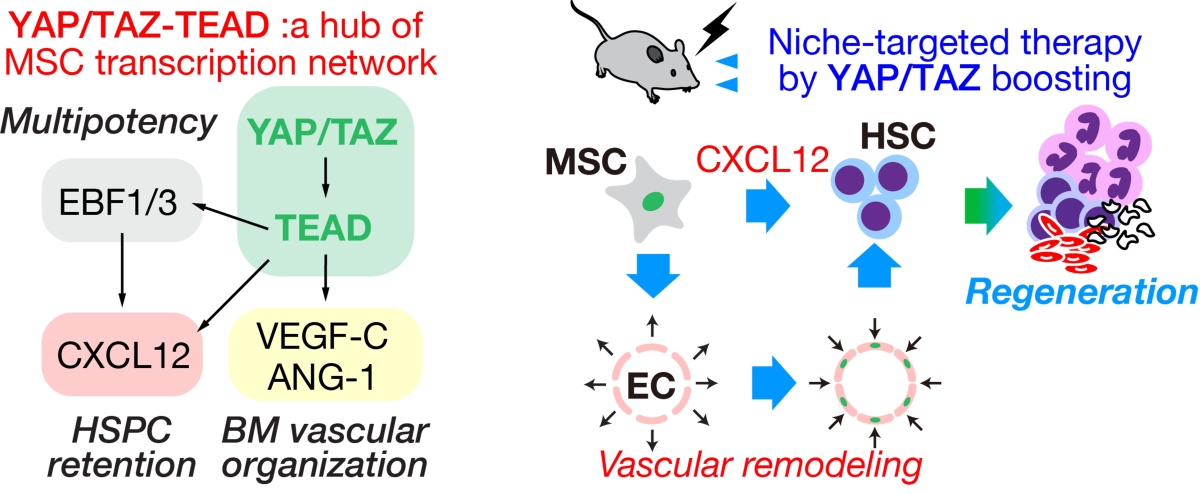
Researchers reveal that the transcription factors YAP and TAZ aid the regeneration of mesenchymal stromal cells and endothelial cells, thus restoring the BM niche. Notably, pharmacological activation of YAP/TAZ by GA-003 enhances BM niche reorganization and accelerates hematopoietic recovery after myeloablative therapies.
Reference
Journal:Blood
Title of original paper:
Niche-targeted therapy via YAP/TAZ activation enhances hematopoietic regeneration
DOI:
10.1182/blood.2025030831
Authors:
Shun Uemura1, Masayuki Yamashita1,2, Takako Yokomizo-Nakano1, Ayako Aihara3, Takumi Iwawaki3, Shuhei Koide1, Yaeko Nakajima-Takagi1, Motohiko Oshima1, Yoshiki Omatsu4,5,6, Yuki Matsumoto7, Yoshiaki Kubota7, Bahityar Rahmutulla8, Atsushi Kaneda8,9, Miki Nishio10, Akira Suzuki10, Takashi Nagasawa4,5,6, Kenta Kagaya3, Taito Nishino11, and Atsushi Iwama1,12,13
Affiliations:
1. Division of Stem Cell and Molecular Medicine, The University of Tokyo, Japan
2. Division of Experimental Hematology, St. Jude Children’s Research Hospital, USA
3. Biological Research Laboratories, Nissan Chemical Corporation, Japan
4. Laboratory of Stem Cell Biology and Developmental Immunology, Osaka University, Japan
5. Graduate School of Medicine, Osaka University, Japan
6. Immunology Frontier Research Center (WPI-IFReC), Osaka University, Japan
7. Department of Anatomy, Keio University School of Medicine, Japan
8. Department of Molecular Oncology, Chiba University, Japan
9. Health and Disease Omics Center, Chiba University, Japan
10. Division of Molecular and Cellular Biology, Kobe University Graduate School of Medicine, Japan
11. Head Office, Nissan Chemical Corporation, Japan
12. Laboratory of Cellular and Molecular Chemistry, The University of Tokyo, Japan
13. The University of Tokyo Pandemic Preparedness, Infection and Advanced Research Center (UTOPIA), The University of Tokyo, Japan
About The Institute of Medical Science, The University of Tokyo
The Institute of Medical Science, The University of Tokyo (IMSUT), established in 1892 as the Institute of Infectious Diseases and renamed IMSUT in 1967, is a leading research institution with a rich history spanning over 130 years. It focuses on exploring biological phenomena and disease principles to develop innovative strategies for disease prevention and treatment. IMSUT fosters a collaborative, interdisciplinary research environment and is known for its work in genomic medicine, regenerative medicine, and advanced medical approaches like gene therapy and AI in healthcare. It operates core research departments and numerous specialized centers, including the Human Genome Center and the Advanced Clinical Research Center, and is recognized as Japan’s only International Joint Usage/Research Center in life sciences.About Professor Atsushi Iwama from the Institute of Medical Science, The University of Tokyo
Dr. Atsushi Iwama is a Professor at The Institute of Medical Science, The University of Tokyo, Japan. He graduated from the School of Medicine, Niigata University in 1987. His research primarily focuses on hematopoietic stem cells, hematological malignancies, aging, and epigenetics. He has authored over 300 publications and has contributed extensively to the fields of medicine and biochemistry, genetics, and molecular biology.Funding information
This work was supported in part by Grants-in-Aid for Scientific Research (19H05653, 24H00066, 19H05746, 23K19622, 24K19218, 24KJ0053, 22H03101) from the Japan Society for the Promotion of Science (JSPS), 21zf0127003h0001, 25jf0126013h0001, and 243fa627001 (AI) from the Japan Agency for Medical Research and Development (AMED), and Nissan Chemical Corporation.Media contact
Affiliation: Project Coordination Office, The Institute of Medical Science, The University of Tokyohttps://www.ims.u-tokyo.ac.jp/