Graphic
2024
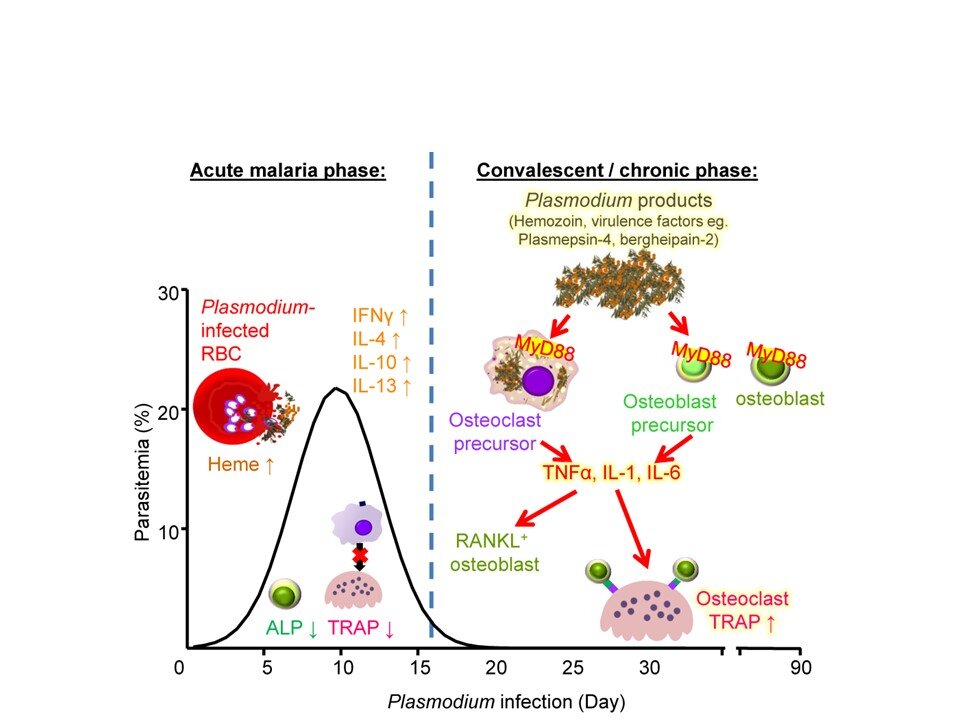
2024.MyD88 in osteoclast and osteoblast lineages differentially controls bone remodeling in homeostasis and malaria.


2021-2022
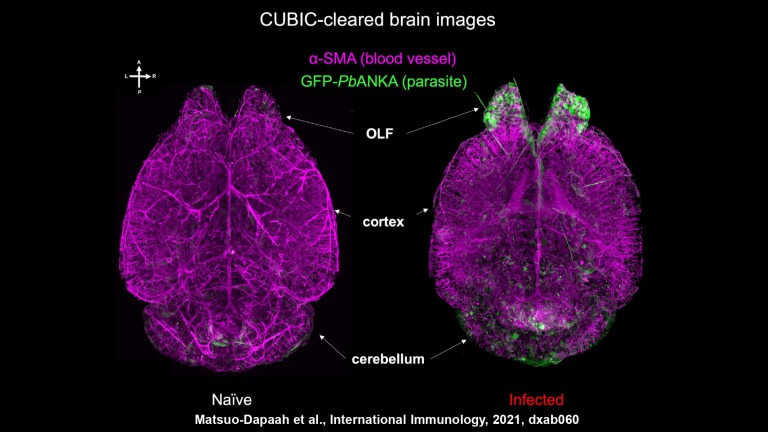
A new method to visualize cerebral malaria
At November 2021 issue of International Immunology, Volume 33, Issue 11,
November 2021, Pages 587–594, https://doi.org/10.1093/intimm/dxab06. Cerebral malaria (CM) is the major cause of death inPlasmodium falciparum-infected humans. The mechanisms are not fully established although sequestration
of infected erythrocytes in microvessels is thought to play an important
role. In their Short Communication,Matsuo-Dapaah et al.construct 3-dimensionl images of single microvessels deep in the whole
brain using a new method—clear, unobstructed, brain/body imaging cocktails
and computational analysis (CUBIC) with light sheet fluorescent microscopy
(LSFM). They use this method in experimental cerebral malaria, in which
mice are infected withPlasmodium bergheiANKA. The parasites are shown to preferentially accumulate in the capillaries
and tissue of the olfactory bulb (see figure) rather than other areas of
the brain. If the bulk of the olfactory bulb is removed, parasites are
shown to accumulate in the brainstem. This method should prove valuable
for efforts to characterize the interactions between infected erythrocytes
and blood microvessels in the brain and may even be applicable to post-mortem
human tissue.
2020
2019
2018
2017